Why this question comes up so often
Homeowners search for "roller blinds" and "roller shades" almost interchangeably, and honestly, most people in the industry use the terms loosely too. If you ask five different showrooms, you might get five slightly different answers. But there is a real distinction worth knowing, especially once you start comparing fabric samples and trying to pick the right one for your home.
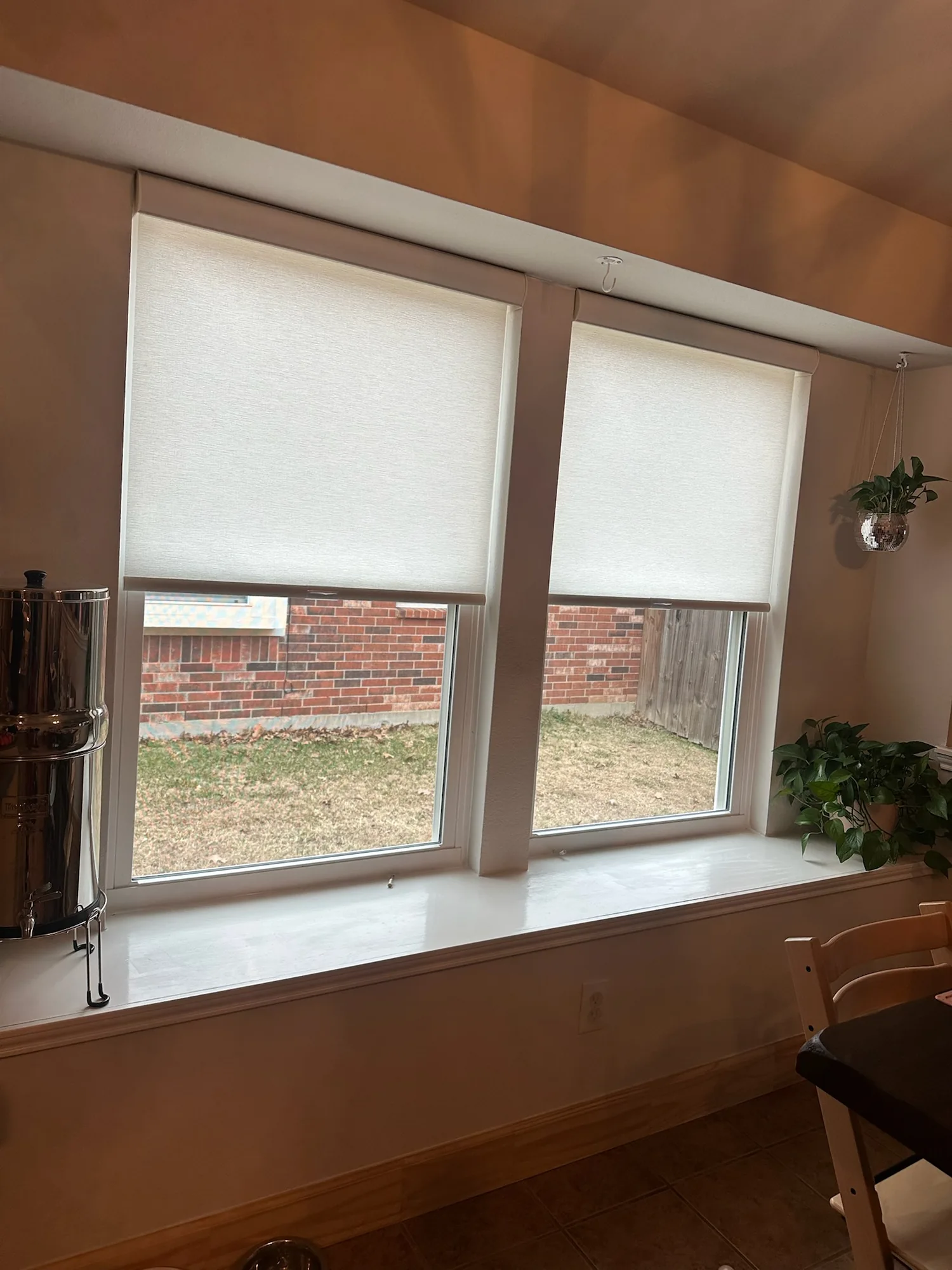
Both roller blinds and roller shades work the same basic way. A single piece of material wraps around a tube at the top of the window. Pull it down for coverage, roll it up to let light in. The mechanism is nearly identical. The difference is mostly in the material and what that material does to the light coming through.
Roller shades: soft fabric, filtered light
When most window treatment companies say "roller shade," they mean a shade made from a woven or knit fabric. These fabrics range from sheer, which lets in a lot of light and a soft view of the outdoors, to blackout, which blocks nearly all light and outside visibility.
Roller shades come in a wide range of colors, weaves, and openness levels. Openness refers to how tightly the fabric is woven. A more open weave lets more light and a partial view through even when the shade is down. A tighter weave blocks more light and privacy.
Because the fabric is soft, roller shades tend to have a warmer, more residential feel. They are a popular choice for living rooms, bedrooms, and kitchens where you want a balance of light control and a finished look.
Roller blinds: stiffer material, harder edge
"Roller blinds" more often refers to a stiffer material, like a vinyl or PVC based roll, sometimes with a slicker or more uniform surface than woven fabric. This term shows up more in commercial settings or budget residential products, though plenty of home style options exist too.
Because the material is stiffer, roller blinds can have a more uniform, almost architectural look. They often come in a narrower range of colors and textures compared to fabric roller shades, and the surface can feel more like a hard material than a textile.
The practical differences that matter
Once you get past the terminology confusion, here is what actually changes between the two.
- Material feel: soft woven fabric versus a stiffer, more uniform roll material.
- Light control range: fabric roller shades offer more granular choices, from sheer to blackout, since openness is a spectrum. Stiffer roller blinds tend to be more blackout or more see-through, with less of a middle ground.
- Look and texture: fabric shades usually read as softer and more residential. Stiffer materials can look cleaner and more modern, but sometimes less cozy.
- Color and pattern options: fabric roller shades typically offer a much larger selection of colors, textures, and even patterns.
- Cost: stiffer vinyl style rolls are often on the lower end of the price range, while fabric roller shades span a wider range depending on the fabric quality.
Which one fits your home
For most living spaces, bedrooms, and dining rooms, a fabric roller shade is the more common choice. It gives you a softer look and more flexibility in exactly how much light and privacy you want. If you are outfitting a laundry room, garage window, or a rental property where budget and simplicity matter most, a stiffer roller blind material can get the job done at a lower price point.
Neither option is objectively better. It comes down to the room, your budget, and how much you care about the exact look and feel of the material. If you like the idea of a clean, minimal roll up shade but are not sure whether fabric or a stiffer material is right for a specific window, that is a completely normal thing to bring up during a consultation.
A note on light control settings
Both roller shades and roller blinds are usually available in three general light control categories.
- Sheer or light filtering: softens harsh sun and glare while keeping the room bright.
- Room darkening: blocks most light while still allowing a small amount through the edges.
- Blackout: blocks essentially all light, useful for bedrooms or media rooms.
Fabric roller shades usually offer more shades of gray, so to speak, between these categories. Stiffer roller blind materials tend to jump more directly between very open and nearly opaque.
Installation and mounting options
Both styles can be mounted inside the window frame for a clean, built in look, or outside the frame when you want more coverage or the window frame is not deep enough for an inside mount. Fabric roller shades and stiffer roller blinds both use the same basic bracket and tube hardware, so the mounting decision usually comes down to the window itself rather than the material choice.
Cordless and motorized lift systems are common on both types now too. A cordless lift is a smart choice for homes with kids or pets, since there is no hanging cord to get tangled up. Motorized versions can be set on a schedule or controlled from a phone, which is handy for large windows or hard to reach spots like a kitchen sink window.
Cleaning and everyday care
Fabric roller shades can usually be cleaned with a vacuum brush attachment or a light dusting cloth. Because the fabric is woven, it can trap a bit more dust than a smoother material, so an occasional vacuum keeps it looking fresh. Stiffer vinyl style roller blinds wipe clean easily with a damp cloth, since the surface does not hold onto dust the same way fabric does. Neither option requires anything beyond routine dusting for most households.
Not sure which type or light control level makes sense for your windows? Matt Diaz can bring actual fabric and material samples to your home so you can see how light passes through each option in your own rooms before you decide.
Ready to compare samples in person? Reach out through our contact page or call (844) 936-2446 to book your free in-home consultation.